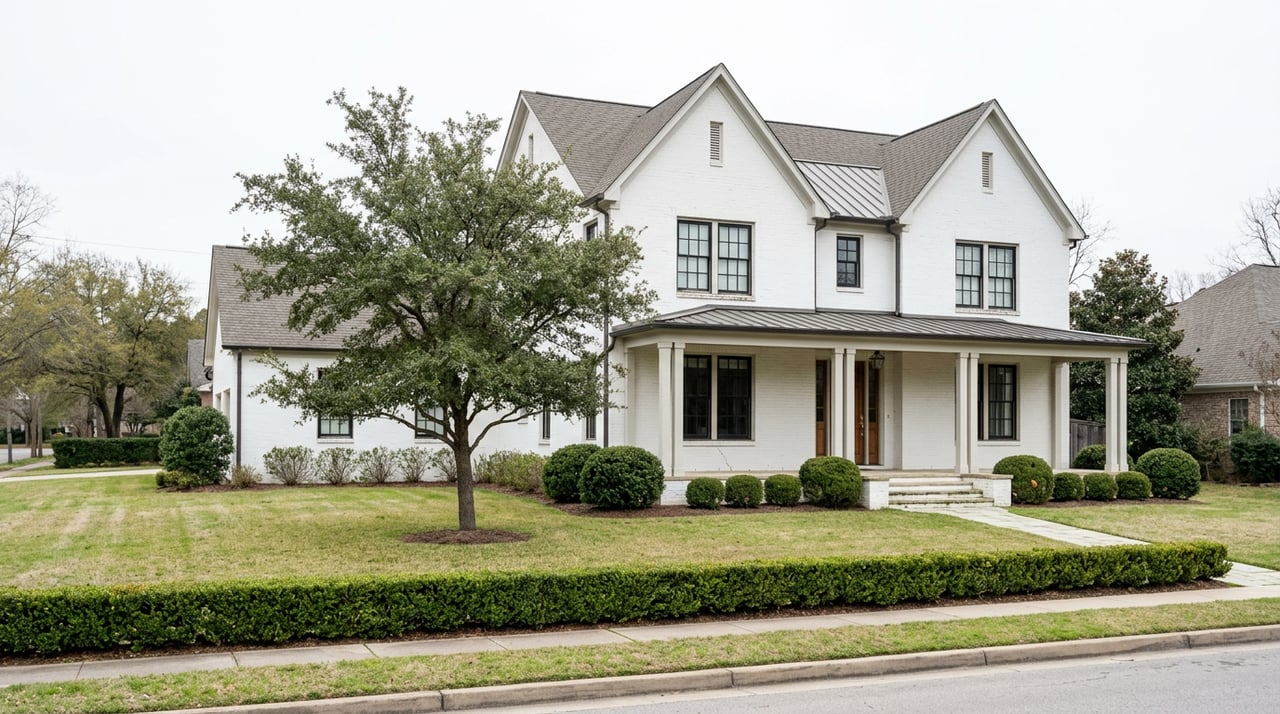
The House on Enfield Road That Explains Why Pemberton Heights Prices Don't Line Up
September 24, 2026
September 24, 2026
In August 2024, an owner filed paperwork with the City of Austin to demolish a two-story house at 1106 Enfield Road, a Mission Revival built around 1926 with stucco cladding, arched limestone details, and a tile roof. The property sits inside the Old West Austin National Register Historic District, the designation that covers Pemberton Heights along with Old Enfield and Bryker Woods. Before the city could release a demolition permit, the case had to go in front of the Historic Landmark Commission. The Old West Austin Neighborhood Association filed a formal objection, arguing the request was really about clearing the lot to make it easier to sell.
That single filing is a useful lesson for anyone comparing Pemberton Heights to another Central Austin neighborhood on price alone. The house on Enfield Road did not sit inside some extra-protected historic zone that made demolition impossible. It sat inside the lightest of three separate layers of historic status that apply, unevenly, across this neighborhood. Two addresses on the same block, built in the same decade, can carry completely different answers to the question of what a buyer is actually allowed to do with the property after closing. That difference, more than square footage or lot size, is why a published median price for Pemberton Heights rarely means what it appears to mean.
Pemberton Heights carries the word "historic" loosely, and that looseness is the whole story. There are three distinct designations that can apply to a given house, and each one triggers a different level of review.
The broadest layer is membership in the Old West Austin National Register Historic District, added to the National Register of Historic Places in 2003. Neighbors pursued that listing partly to stop a proposed widening of MoPac that they feared could take as many as 80 houses, since federal dollars for the project would have required extra review of any demolition inside a registered district. What National Register status does not do is give the city design control over a private renovation. Its narrower, practical effect shows up at the point of demolition or relocation: under the city's land development code, a building considered "contributing" to the district cannot get a demolition or relocation permit released until the Historic Landmark Commission has reviewed the application. That is the exact process the Enfield Road house went through.
The second layer applies regardless of district membership. Any building 45 years or older in Austin triggers an automatic review of exterior work through the city's Historic Preservation Office, looking for potentially significant properties. Since most Pemberton Heights homes date from the late 1920s through the 1960s, this review touches nearly every exterior permit filed in the neighborhood, whether or not the owner thinks of the house as historic at all. Interior remodeling is unaffected.
The third and strongest layer is individual Austin Historic Landmark designation. More than 40 homes in Pemberton Heights carry this status, including the Keith House near the Windsor Road entrance and the Reed Estate on Harris Boulevard. Landmark status brings full design review for exterior changes, not just demolition, and can qualify an owner for an annual partial property tax exemption through Travis County, provided the building meets maintenance standards.
| Layer | What it covers | What it can stop | Tax effect |
|---|---|---|---|
| National Register district (since 2003) | Contributing structures across Pemberton Heights, Old Enfield, and Bryker Woods | Demolition or relocation permits, pending Historic Landmark Commission review | None automatically |
| 45-year exterior review | Any building of that age, district or not | Street-visible exterior changes that alter form | None |
| Individual Historic Landmark | Roughly 40+ specific addresses, such as the Keith House and the Reed Estate | Any exterior alteration, not just demolition | Annual partial exemption, if applied for and maintained |
What Pemberton Heights does not have is City of Austin Local Historic District status, the designation that would layer district-wide design standards on every contributing property and open owners to the city's rehabilitation tax abatement, a benefit that can zero out city property taxes on the added value from a qualifying restoration for several years. Neighboring Bryker Woods has discussed pursuing that step, precisely because National Register listing alone does not stop the kind of teardown Enfield Road tested.
It's worth being precise about what the Historic Landmark Commission's involvement actually means. The commission's role in a National Register district is advisory unless the specific property independently qualifies as a landmark. Its job is to review and make recommendations, not to grant or deny the concept of demolition outright. The neighborhood association's objection letter raised practical points too: Enfield Road at that stretch is a sloped, curved, one-way section that neighbors consider dangerous for construction traffic, and the area already had other properties sitting unsold at asking prices the current market wasn't supporting. None of that changes the legal mechanism. A National Register contributing structure gets a hearing. It does not get a guarantee.
That distinction matters because it's easy to assume "historic district" means "protected," full stop. The Enfield Road filing shows the protection is procedural, not automatic. A buyer evaluating a contributing-only property should expect that a future owner, including themselves, could clear the lot after the same review process, not before it.
The Old West Austin Historic District, as a whole, includes roughly 1,600 homes across all three of its component neighborhoods, according to city planning documentation. Pemberton Heights is a fraction of that total. A neighborhood this size, with three different designation outcomes possible on any given block, produces a comp set where the underlying properties aren't actually comparable to each other, even when a listing platform groups them under the same ZIP code and neighborhood name.
Picture two recent transactions. One is a modest 1930s cottage on a large lot, priced at the lower end of the range, trading mostly on land value because a buyer believes it can clear the same demolition review that Enfield Road went through. The other is a landmarked estate near the Reed property, priced well above that, trading on architecture that cannot be altered without a public hearing. Both show up in the same "Pemberton Heights" search. Neither number tells a shopper anything reliable about the other, and averaging them into a single median obscures the reason they differ in the first place.
If you're weighing a specific address here against another Central Austin option, the median price is the wrong starting question. These are the ones that actually matter:
These questions surface the kind of friction that only shows up once an offer is written, not while browsing listing photos.
Is Pemberton Heights a City of Austin Local Historic District? No. It sits inside the Old West Austin National Register Historic District, a different and lighter designation. National Register status alone did not stop the demolition attempt at Enfield Road. It guaranteed the Historic Landmark Commission got to weigh in first.
Does individual landmark status lower my property taxes automatically? Not automatically. Owners of individually designated Austin Historic Landmarks can apply annually to Travis County for a partial exemption, but the property has to meet maintenance standards and the owner has to file. It's a separate mechanism from the rehabilitation tax abatement available in a true Local Historic District, which Pemberton Heights does not have.
Does the 45-year review mean I need city approval to remodel my kitchen? No. That review applies to street-visible exterior changes, additions, roofline or dormer alterations, window pattern changes, and similar work. Interior remodeling that doesn't touch the exterior generally isn't affected.
Comparing homes in a neighborhood like this by price per square foot alone will always flatten details that matter more than the number itself. Knowing which of these three layers applies to a specific address, before you fall in love with the house or the lot, is what actually protects your plans and your budget.
If you're weighing a purchase or a sale in Pemberton Heights, Old Enfield, or another Central Austin neighborhood where these questions come up address by address, Lillian Singh can walk through what applies to the specific property you have in mind. Let's Connect.
Stay up to date on the latest real estate trends.

Discover a real estate experience defined by trust, expertise, and heartfelt dedication. Lillian's lifelong understanding of what “home” truly means guides every client and every decision.
Get In Touch With Our Team To Learn More

Lillian Singh
ADDRESS 2500 Bee Caves Road, Building 3 Austin, TX 78746